Nobel Prize in chemistry 2025 awarded for development of MOFs
Cutting-edge research on metal organic frameworks also in Erlangen
The 2025 Nobel Prize for chemistry has been awarded to Susumu Kitagawa, Richard Robson and Omar M. Yaghi for the development of a new type of molecular architecture. The constructions they created – metal–organic frameworks (MOFs) – contain large cavities in which molecules can flow in and out. Researchers in laboratories around the world including FAU have used them to create nanoreactors for catalytic transformations, extract pollutants from water, capture carbon dioxide and store hydrogen. Other constructions of this type are tailormade for separation of gases, delivering pharmaceuticals in the body or managing extremely toxic gases. Some can trap the ethylene gas from fruit – so they ripen more slowly – or encapsulate enzymes that break down traces of antibiotics in the environment.
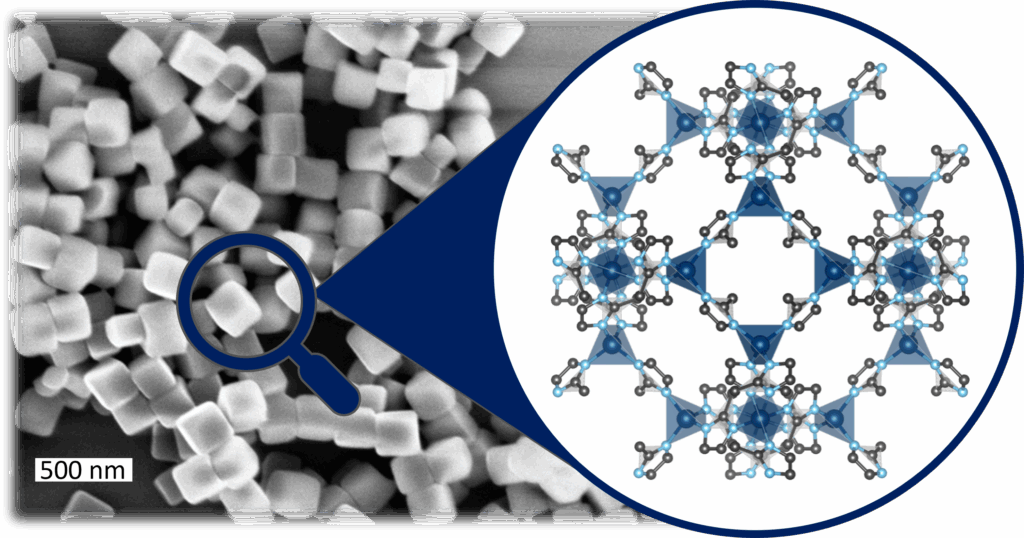
MOFs are an incredible example of how precise control over particle composition, pore size and morphology can give rise to astonishing proprieties. The Hartmann group has been pushing the field for 20 years by preparing and characterizing MOFs for various application in catalysis, gas separation, enzyme immobilization and hydrogen storage. Recent papers deal with carbon capture (10.1021/acs.inorgchem.5c02921) and luminescent MOFs for temperature sensing (DOI: 10.1039/d5ra00822k). Particular emphasis has been placed on spectroscopic characterization of MOFs employing solid-state NMR and ESR spectroscopy and the elucidation of their formation mechanisms on the molecular and macroscopic level by in situ spectroscopic and acoustic techniques. Moreover, Martin Hartmann was co-organizing the first international conference on MOFs in Augsburg in 2008, when the group was located at the University of Augsburg.
The recently-awarded Nobel Prize shines light on the relevance of the research performed in the Hartmann group, and showcases how rational design of MOFs can actually impact the progresses of technology and improve our daily life.